Ready when you are.
The form is at the top of this page. Date, time, place — the chart is free, always.
Free child birth chart
Enter their birth date, time & place. See the whole cosmic pattern at their moment.
What you get · free
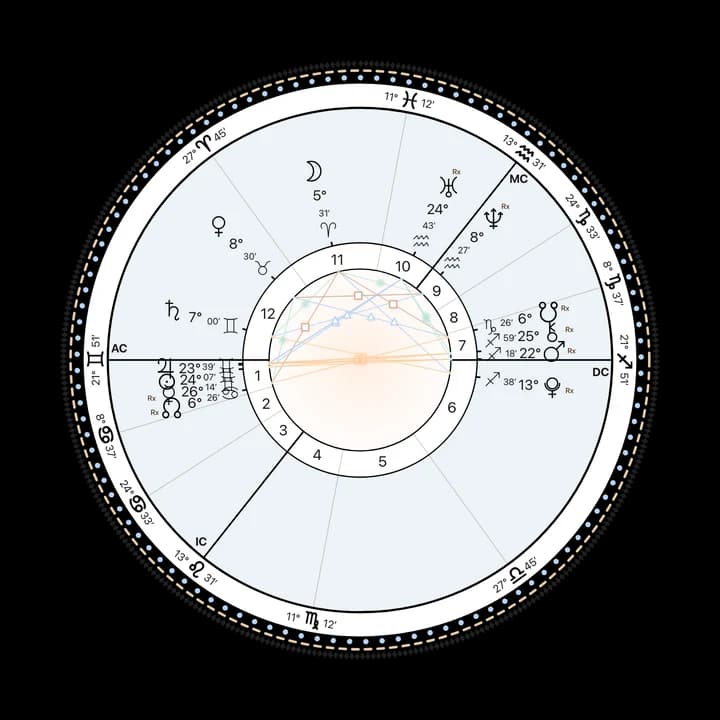
A birth chart for my child is the same chart I could have pulled the day she was born. The sky doesn’t move once they arrive. What moves is what you can see of it. At six weeks, the moon sign is the whole story: how they settle, what soothes, why the swaddle works for one baby & enrages another. By four, Mercury has walked in the door (the questions, oh, the questions). By seven, Mars is running the playground.
So a child astrology chart reads differently from a baby chart because the child is showing you more of it. The Leo rising that looked like a big grin in the bassinet is now a kid who narrates their own bath. The Capricorn moon that seemed like an easy baby is now a five-year-old who needs to know the plan for tomorrow before they can sleep tonight. Specific. Recognizable. Already there on the wheel.
I pull my own son’s chart back out every few months. Same wheel. I see something new each time, because he’s grown into another line of it.
Birth date, birth place & birth time, as exact as you can manage. For a kid’s birth chart the time still matters as much as it did on day one. It sets the rising sign, the houses & (on some days) the moon sign, & those three carry most of what you’ll recognize.
The birth certificate has it. So does the hospital discharge summary, the baby book, the first photo’s timestamp, or the grandparent who was watching the clock in the waiting room. If it’s gone for good, enter the chart without it. You’ll still see the sun, the planets & the aspects between them, & the moon sign holds on most days. Details in do you need a birth time?
The full natal chart, calculated to the degree from the same ephemeris data astronomers use. Free, on this page.
The baby & child reading is fourteen chapters written from your child’s exact chart. Their core essence. Their emotional world & what safety feels like to them. How they think & learn, how they play, how they push, how they love. What they need from you when the day tips over, & the particular ways they come back. $39, once, as a keepsake PDF you can print or keep on your phone.
Every chapter names the placement it comes from, so you can hold it up against the wheel & check. If a line could describe any child on earth, it didn’t make the cut.
Parents tell me the reading gives them words for things they’d already noticed. (“She’s just like that” finally has a “that.”) That’s the whole point. You already know your kid. This helps you say what you know.
A child’s chart is a document you return to. Toddler will? Look at Mars & the moon. First year of school? Mercury & the third house. Big feelings at eight that seem to come from nowhere? Venus, the moon & whatever Saturn is doing. The chart stays put; your questions change; the answers were sitting there the whole time.
One thing I want to say directly, because I’ve watched parents flinch at it: nothing in a child’s chart is a diagnosis. Every placement holds a range. A tense Mars can be reactivity at three & courage at thirteen, & the home you build is a big part of which one grows. The chart describes the instrument. You’re both still writing the music.
For a hand to hold while you read it, start with how to read your child’s birth chart. Then pull the wheel above & see who you’ve been living with. (You probably already know. Isn’t it something to see it written down?)
Yes. A child’s birth chart is calculated exactly the way an adult’s is, from their birth date, time & place. The chart is set at birth & never changes; what changes is how much of it a child is old enough to show you. The calculator on this page is free & works for any age.
Temperament, mostly: how your child processes feelings (the moon), how they meet new situations (the rising sign), how they learn & communicate (Mercury), how they assert themselves (Mars) & how they give & receive affection (Venus). It describes a range of expression, so read it as a lens for the child you have today.
Start with the Big Three: sun, moon & rising. Read the moon first, because it explains most day-to-day behavior in young children. Then look at Mercury for learning style & Mars for will. The aspects (the angles between planets) explain why two placements pull against each other. A full walkthrough is in the guide linked on this page.
For young children, often yes. The sun describes who they are growing into; the moon describes how they feel right now, what soothes them & what overwhelms them. Parents usually recognize their child in the moon sign before anything else. As kids get older, the sun & rising become more visible.
Yes. The free child birth chart on this page includes the full wheel, the sun, moon & rising with short descriptions, every planetary placement with sign & degree, the moon phase & the full aspect list. The written fourteen-chapter reading is a one-time purchase if you want the full interpretation.
The form is at the top of this page. Date, time, place — the chart is free, always.